
News Summary
Burrowes’ Lexington Mustard, historically favored by Queen Victoria, highlights a unique part of Kentucky’s culinary heritage. This distinctive condiment, created in the early 1800s by Nathan Burrowes, has sparked interest among researchers and food historians as they seek to uncover its original recipe and production history. The mustard gained acclaim under Samuel McCullough, winning an award at the 1851 World’s Exposition, before the brand faced eventual decline. Current efforts are underway to explore its development and marketing, aiming to revive interest in this legendary condiment.
Lexington, Kentucky – The Legacy of Burrowes’ Lexington Mustard
Burrowes’ Lexington Mustard, a once-renowned condiment that found favor with Queen Victoria, reflects a fascinating chapter in Kentucky’s culinary history. This distinctive mustard, perfected in the early 19th century, has intrigued historians, food lovers, and journalists alike, leading to ongoing research into its original recipe and production methods.
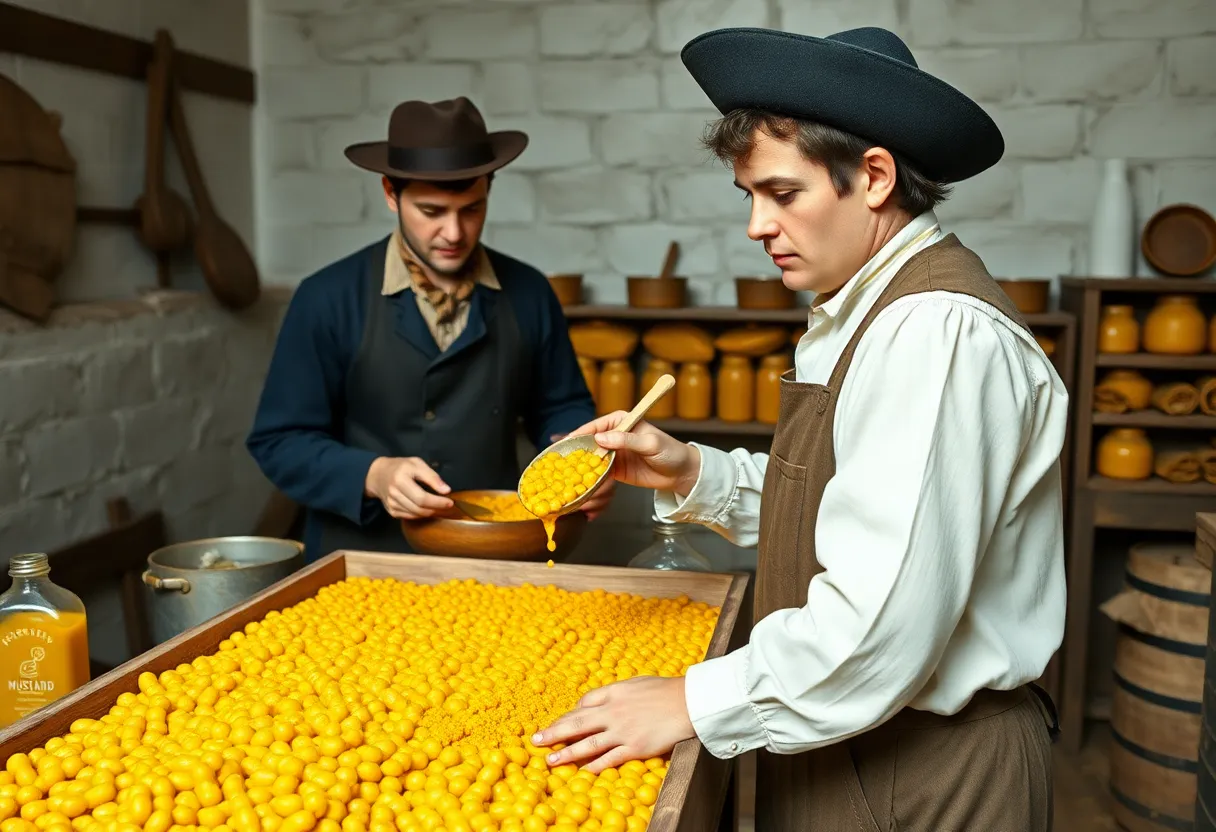
Nathan Burrowes, an early settler from Pennsylvania, arrived in Lexington during the 1780s. Initially, he focused on creating a machine to strip leaves and debris from hemp stalks. This innovation, however, faced difficulties as competitors quickly copied his design, resulting in financial hardships for Burrowes. Recognizing the need for a change in direction, he eventually transitioned to mustard production, completing a well-guarded recipe for table mustard by 1810.
Following Burrowes’ death, his legacy was carried on by Samuel McCullough, who took over the mustard company in 1841. Described as a close confidant and likened to a son, McCullough inherited the treasured mustard recipe. Under his stewardship, Burrowes’ Lexington Mustard gained significant recognition, famously winning an award at the 1851 World’s Exposition. Notably, during this period, it was claimed that Queen Victoria herself enjoyed the mustard, enhancing its status on the international stage.
The company changed hands again in 1869 when John Brand acquired it and relocated operations to Louisville. However, the brand faced challenges, including a copyright lawsuit initiated by other mustard manufacturers who contested the validity of Burrowes’ original recipe. Despite these struggles, Burrowes’ Lexington Mustard remained a formidable presence until it ceased production around 1893.
In an effort to unearth more about this historical condiment, researchers have been examining its development and marketing narratives. A key resource in this quest is a 2022 publication from the Lexington History Museum, which elaborates on the mustard’s backstory and its copyright disputes but conspicuously omits the coveted recipe itself. Analysis indicates that Burrowes’ mustard was likely sold in a powdered form before prepared mustard became common, making the search for an exact recipe particularly challenging.
Various online recipes claim to replicate Burrowes’ creation, yet none offer a definitive source or assurance of authenticity. The methods employed by Nathan Burrowes during production are equally elusive, adding another layer of complexity to this culinary mystery. Notably, attempts to find archival records at the National Mustard Museum in Middleton, Wisconsin, yielded no results pertaining to Lexington Mustard, leaving enthusiasts and historians with few leads.
The search has also included references to the 1872 book “History of Lexington, Kentucky: Its Early Annals and Recent Progress.” This volume described the original recipe as top-secret, passed on through tradition without ever being fully disclosed. Furthermore, historic accounts quote McCullough praising Burrowes’ mustard as “the best mustard the world has ever seen,” underlining the product’s esteemed reputation during its peak.
Throughout this investigation, various spellings of Burrowes’ last name have emerged, including Burrowes, Burrows, Burrow, and Burroughs. To maintain consistency in documentation, Burrowes has been retained as the chosen spelling.
The ongoing journey into the history of Burrowes’ Lexington Mustard embodies the joys of journalism, revealing community connections and sparking curiosity about culinary traditions. Researchers and enthusiasts alike are encouraged to share any insights or information regarding Lexington Mustard, as collective efforts may eventually uncover the elusive original recipe.
Deeper Dive: News & Info About This Topic
HERE Resources
Lexington Celebrates 250 Years of Unique Culinary Heritage
Tony’s of Lexington Crab Cake Earns Rave Reviews for Its Unique Size and Quality
Penny’s at Pomegranate Opens in Lexington
Family in Crisis Over Mistaken Deportation
Wingstop Opens First Location in Lexington
New BBQ Restaurant LX BBQ Opens in Lexington
Additional Resources
- Kentucky.com: Know Your Kentucky
- Wikipedia: Mustard
- MSN: Lexington’s Rich History with Food
- Google Search: Burrowes’ Lexington Mustard
- LEX18: Best of the Bluegrass 2024
- Google Scholar: History of Lexington Mustard
- WKYT: Weekend Roundup
- Encyclopedia Britannica: Kentucky Culinary History
- Eastside Feed: Dough Doughnuts Signage
- Google News: Burrowes’ Mustard


Author: STAFF HERE LEXINGTON KY STAFF
The LEXINGTON STAFF WRITER represents the experienced team at HERELexingtonKY.com, your go-to source for actionable local news and information in Lexington, Fayette County, and beyond. Specializing in "news you can use," we cover essential topics like product reviews for personal and business needs, local business directories, politics, real estate trends, neighborhood insights, and state news affecting the area—with deep expertise drawn from years of dedicated reporting and strong community input, including local press releases and business updates. We deliver top reporting on high-value events such as Woodland Art Fair, Crave Food and Music Festival, and Railbird Festival. Our coverage extends to key organizations like Commerce Lexington and Blue Grass Community Foundation, plus leading businesses in education, manufacturing, and technology that power the local economy such as University of Kentucky, Toyota Motor Manufacturing, and Lexmark. As part of the broader HERE network, including HEREBowlingGreen.com and HERELouisville.com, we provide comprehensive, credible insights into Kentucky's dynamic landscape.